


Formatted Title
In Situ Soil Stabilization to Mitigate PFAS Transport via Stormwater at an AFFF Source Area
Background/Objectives
At the Gerald R. Ford International Airport in Grand Rapids, Michigan, historical mandated Federal Aviation Administration (FAA) Part 139 foam testing activities have resulted in discharges of aqueous film-forming foam (AFFF) and elevated concentrations of per- and polyfluoroalkyl substances (PFAS), especially perfluorooctane sulfonic acid (PFOS), in shallow soils and stormwater. Previous site investigations have determined that stormwater runoff and airport underdrain flow from areas adjacent to the Aircraft Rescue and Fire Fighting (ARFF) facility have contributed significant PFAS loading to stormwater flows. These areas around the ARFF are level, with little slope, and covered in pavement or grass, and shallow soils at the site are comprised of topsoil and thick clay that significantly limits infiltration. Past site investigations have shown PFAS attenuation with depth and led to a conceptual site model with stormwater discharge as the main means of PFAS mass flux.
Approach/Activities
In collaboration with Airport staff and other project team members, CDM Smith developed a grant application for FAA’s Environmental Mitigation Pilot Program. The goal of the program is to demonstrate measurable reductions to aviation impacts on water quality through validation of novel technologies for mitigating soils impacted by PFAS. The scope of the project includes additional characterization of site soils and stormwater and bench-scale and pilot-scale treatability testing of novel PFAS adsorbents that could be mixed in situ at the ARFF facility to adsorb and stabilize PFAS in shallow soils and reduce PFAS concentrations in stormwater runoff. CDM Smith investigated the planned pilot cell locations using lysimetry, opportunistic water sampling, and both high-resolution site characterization (HRSC) borings and borings with fewer vertical samples. The field efforts characterized the horizontal and vertical nature and extent of PFAS, the physical and chemical properties of the shallow soils, and quantified the nature of PFAS contamination. Geochemical characteristics of stormwater runoff, porewater, and underdrain flow were also evaluated. CDM Smith conducted batch experiments with three different site soil types (topsoil, clay, and a 50/50 mix), two different amendments (RemBind and Fluoro-sorb) and three different dosages for each, PFAS-free rainwater, and six soil wetting and drying cycles to generate simulated rainwater and measure the effectiveness in terms of PFAS concentration reduction compared to the control. Select split samples will also be centrifuged at ~25,000 relative centrifugal force to assess potential PFAS colloidal transport. Once all bench-scale analytical data are received, CDM Smith will implement a pilot test to amend the selected adsorbent into the test cell and to monitor stormwater from the amended and control test cells. Implementation of the field pilot is expected in March/April 2024, and is expected to include two adjacent test cells (control and treated). The cells will be sealed to prevent lateral subsurface and surface water flow (run-on) and configured to facilitate stormwater sampling for understanding amendment effectiveness.
Results/Lessons Learned
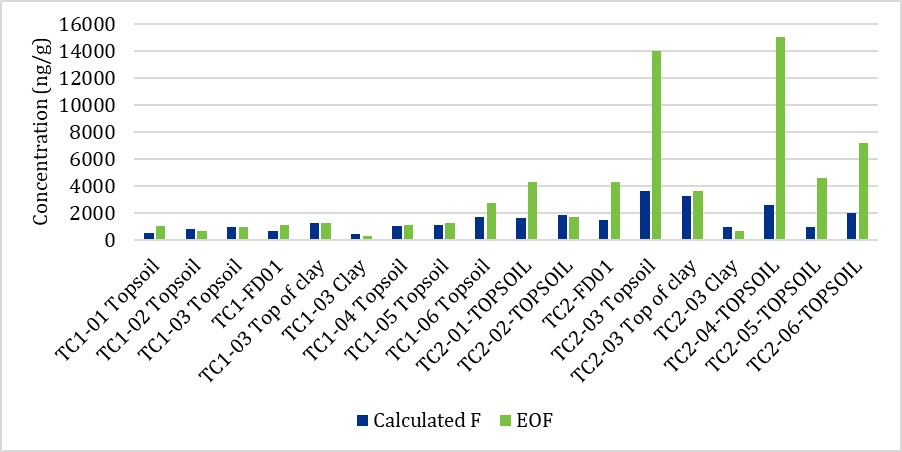
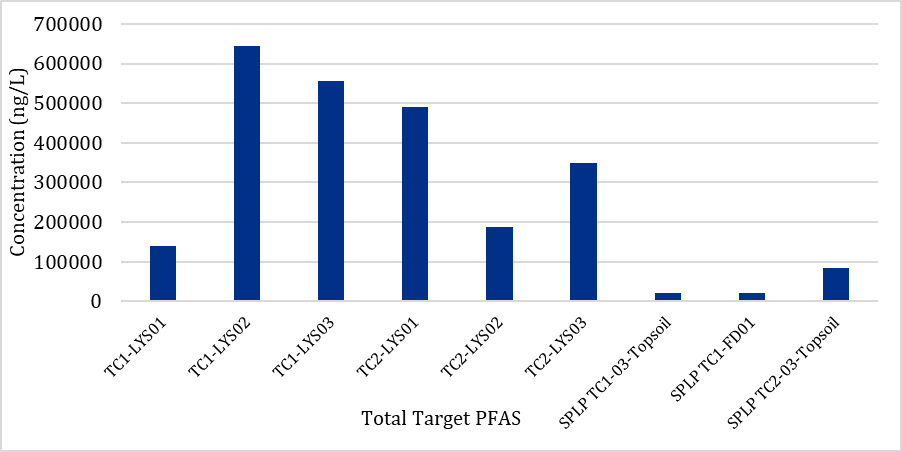
Pre-pilot investigation data confirmed significant PFAS impacts in the selected pilot test area. Soil impacts were dominated by PFOS along with precursors 4:2 fluorotelomer sulfonate (FTS), 6:2 FTS, and 8:2 FTS. Comparison of extractable organic fluorine (EOF) and calculated total fluorine concentrations based on target PFAS analyses showed general agreement, indicating most soils had limited non-target PFAS mass, and limited penetration of PFAS into the clay. However, some of the topsoil samples showed larger differences and thus the presence of more non-target PFAS in contact with surface water (see first figure below). Porewater samples from lysimeters showed significantly higher total target PFAS concentrations compared to leachate from synthetic precipitation leaching procedure (SPLP) testing (second figure below).
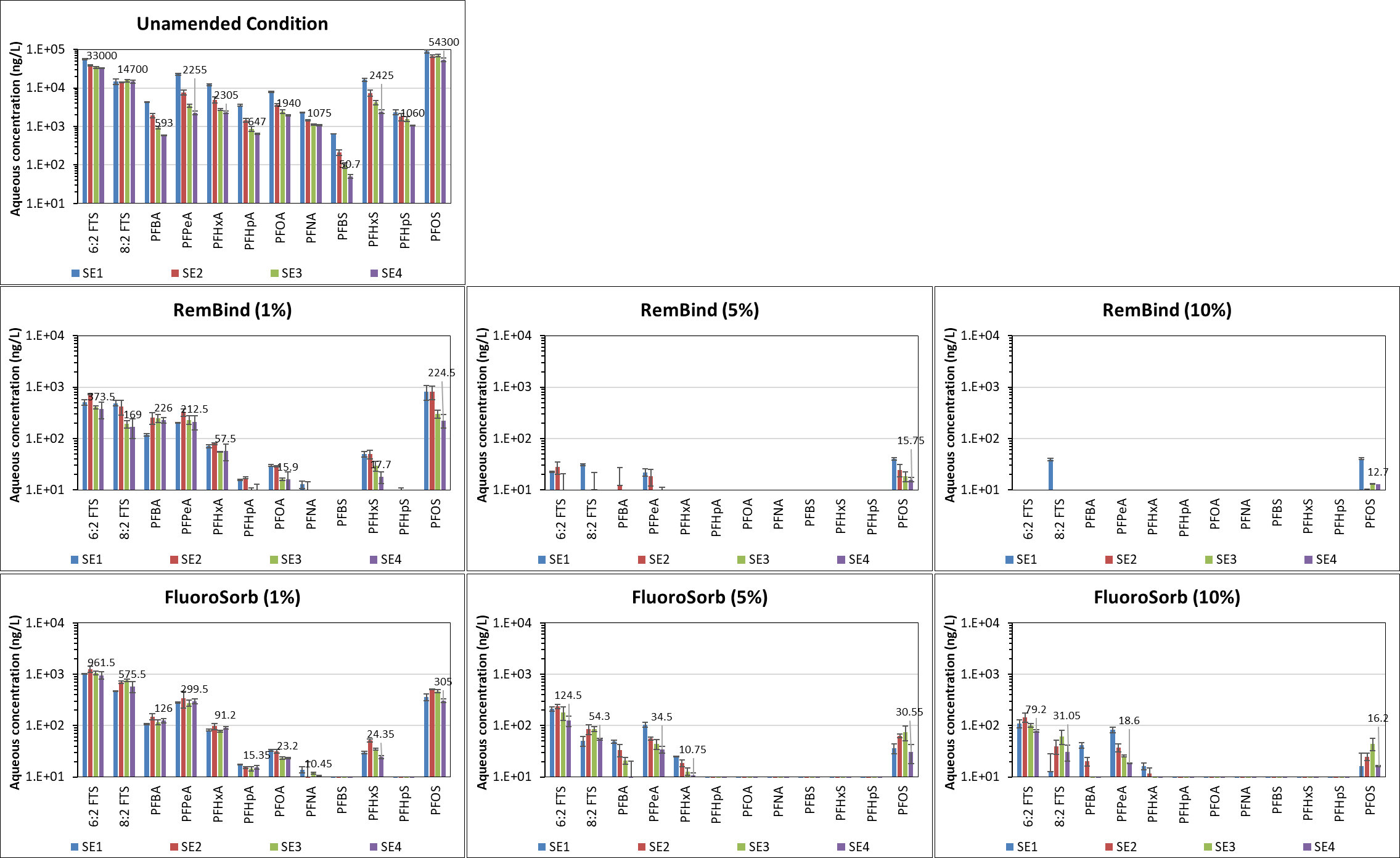
Lab-scale treatability data will be presented describing the sensitivity of simulated surface water PFAS concentrations to soil type, changing amendment dosages, and different amendments (see figures below). Preliminary data received to date from four of the six events indicate very good data reproducibility as indicated by replicate data (error bars on all charts below). As expected, results from unamended soils show significant PFAS desorption with earlier elution of short chain perfluoroalkyl acids (first chart below). While both products have performed similarly in terms of PFOA removal, RemBind controlled some of the PFAA precursors (such as the fluorotelomer carboxylic acids and 6:2 FTS) from the 50/50 topsoil/clay mixture better than Fluoro-sorb. Fluoro-sorb results were also less sensitive to dosage than RemBind, which demonstrated more than 99.9% reduction in aqueous PFAS concentrations.
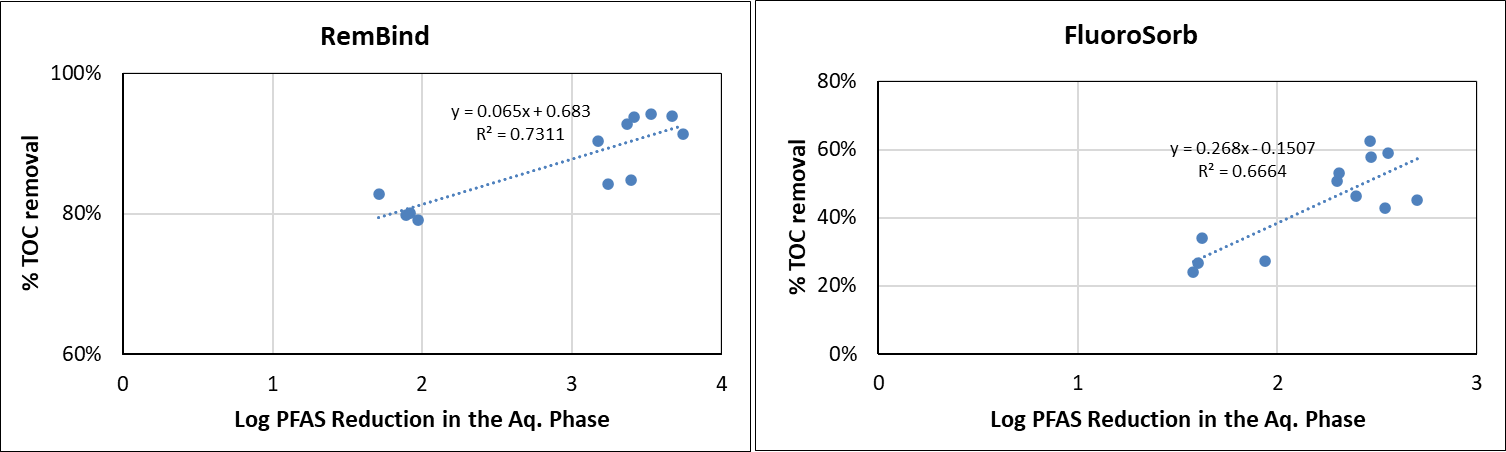
Data will also be presented regarding the effectiveness of using TOC removal as a rapid surrogate analysis for PFAS removal (see figures below).
Lessons learned from lab-scale testing will be discussed, including consideration of potential advantages of this testing approach for this site’s hydrological/geological setting compared to typical leaching methods.
Initial lessons learned from soil mixing during the pilot will also be presented, including test pilot cell configuration, stormwater measurement techniques, and soil mixing techniques and considerations. Potential applicability of this remedial technology to similar ARFF facilities will be discussed, including feasibility with site infrastructure and typical airport/ARFF operations and costs.