
Formatted Title
Removal of Per- and Polyfluoroalkyl Substances from Wastewater via Aerosol Capture
Background/Objectives
Per- and polyfluoroalkyl substances (PFAS) occur widely in the environment due to decades of their use in numerous commercial and industrial applications including fire-fighting foams, metal finishing, textiles, food packaging materials, and consumer products. The widespread use of PFAS-containing products has resulted in the occurrence of PFAS in wastewater treatment plants (WWTPs) arising from commercial and industrial discharges, and potentially from domestic use of consumer products. Conventional wastewater treatment generally does not remove or destroy PFAS, resulting in the release of PFAS through the effluent and biosolids. Therefore, management of PFAS-impacted wastewater is a critical need.
PFAS accumulation at air-water interfaces has been well documented; this PFAS interfacial accumulation has been observed in natural surface water systems and porewater. Recently, these PFAS surface-active properties have been utilized in water treatment. For example, foam fractionation, which employs vigorous aeration and subsequent generation and collection of the PFAS-laden foam to remove PFAS from water, has been shown to be an effective remediation strategy. Another mechanism potentially important to PFAS removal from the aqueous phase during aeration is aerosolization. The generation of aerosols during aeration has been well demonstrated. Both Ebersbach et al. (2016) and Smith et al. (2023) have shown that PFAS-enriched aerosols can be released during aeration of PFAS-impacted waters. Building on the work of Ebersbach et al. (2016), a WWTP wastewater was aerated in a bench-scale reactor, thereby serving as a screening-level surrogate for a full-scale system. Aerosols were characterized and captured, and PFAS removal rates from wastewater were quantified.
Approach/Activities
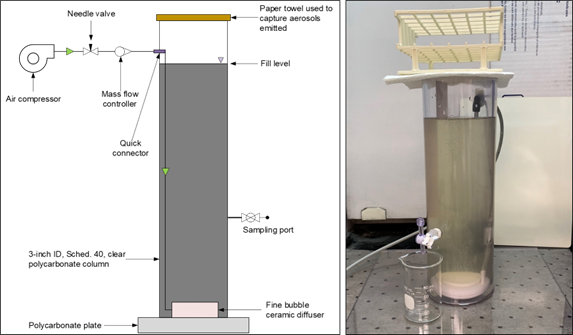
Proof-of-concept bench-scale experiments were performed to measure the extent to which PFAS could be removed from a WWTP if aerosols generated during aeration were captured. A wastewater sample (40 L) collected downstream of the primary settling tanks and at the entrance to the aeration basin at a domestic WWTP located in the northeastern United States was used for testing. A reactor constructed of 8.9-cm inner diameter (ID) Schedule 40 clear polycarbonate tube, and a 0.64-cm thick clear polycarbonate plate, was used to simulate aeration at a WWTP primary aeration basin. A ball valve was installed near the middle of the reactor to facilitate periodic sampling of the bulk aqueous phase. A 5.1-cm ID fine-bubble ceramic diffuser was placed at the bottom of the reactor for aeration. Imaging showed that the median size of the generated bubbles at the air flow rates used for testing was approximately 1 to 2 mm, which is similar to the bubble diameters used in aeration systems employing fine bubble diffusers (2 to 5 mm). Air from an air compressor was used to generate bubbles at approximately 20 and 60 mL/min. Normalized to the volume of wastewater in the reactor, these aeration rates represent approximately one and three times the aeration rates (per water volume) used in the WWTP aeration basin from which the wastewater sample was collected. The water surface area to volume ratio used in the bench-scale system was approximately half that of the full-scale aeration system. The 0.48-cm ID polyurethane line connecting the air compressor to the diffuser was strategically placed on the side of the reactor to minimize disruption to the aeration process. Paper towels were used as the sorbent material to collect aerosols. Background PFAS levels in the sorbent materials were measured prior to testing; none of the 40 PFAS analyzed via Draft EPA Method 1633 was detected in the sorbent material sample. No foam formation was observed in any experiment. Experiments were designed to mimic the aeration rate:water volume ratio, the water volume:surface area ratio, and aeration bubble size applicable to the full-scale aeration vessel.
|
Test condition |
Description |
Aeration rate |
Distance from top of reactor |
|
1 |
Control - no aerosols captured |
20 mL/min |
34 cm |
|
2 |
Low aeration rate with aerosols captured |
20 mL/min |
2.5 cm |
|
3 |
High aeration rate with aerosols captured |
60 mL/min |
2.5 cm |
|
4 |
Low aeration rate with aerosols captured |
20 mL/min |
5.1 cm |
|
5 |
Low aeration rate with aerosols captured |
20 mL/min |
10.1 cm |
Results/Lessons Learned
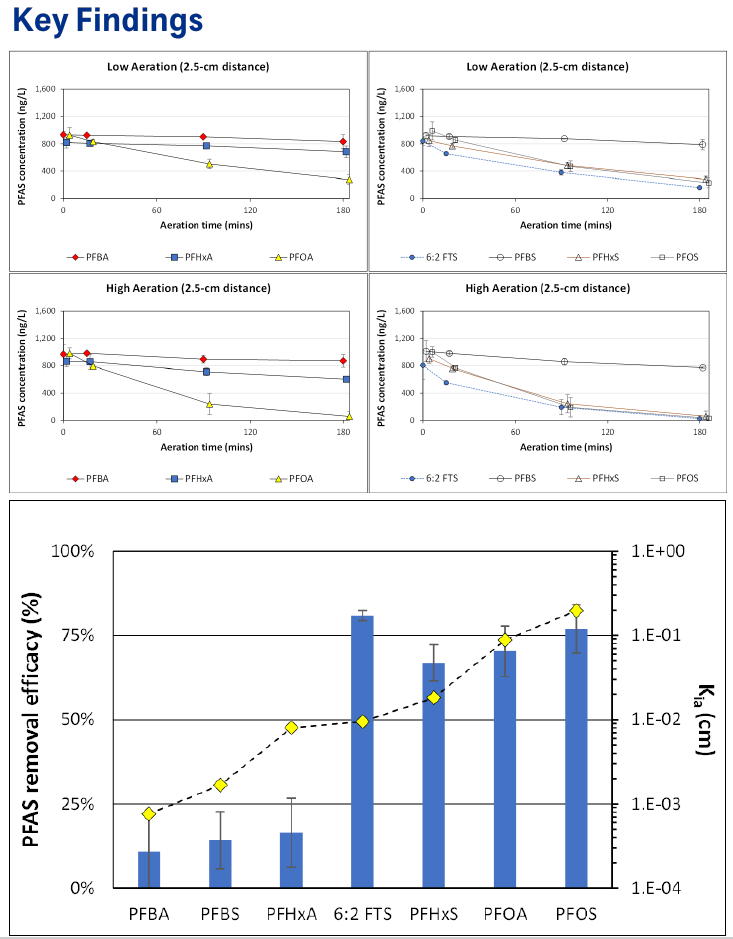
Results from this study demonstrated at a proof-of-concept level that aeration rates typical of those used in domestic wastewater aeration basins are potentially capable of removing substantial quantities of PFAS from wastewater if the emitted aerosols are sufficiently captured. As expected, removal effectiveness was more pronounced for longer-chained and highly surface-active PFAS whereas shorter-chained PFAS were poorly removed. PFAS removal generally increased with improved aerosol capture and with increased aeration rate. Semi-quantifiable PFAS overwhelmingly dominated the PFAS mass present in the raw wastewater, and are expected to account for most of the PFAS mass present in the emitted aerosols. This screening-level study highlights the potential for using aerosolization coupled with aerosol capture as a means to mitigate PFAS present in domestic wastewaters. Results of ongoing preliminary field assessment will also be presented.