
Formatted Title
Column Testing to Assess PFAS Removal Using Various Treatment Media: Lessons Learned and Practical Engineering Considerations
Background/Objectives
Granular activated carbon (GAC), anion exchange resin (AER), and novel sorbent (NS) (albeit to a lesser extent) are technologies commonly employed to treat water containing per- and polyfluoroalkyl substances (PFAS) such as perfluorooctanesulfonic acid (PFOS) and perfluorooctanoic acid (PFOA). Currently, several vendors offer GAC, AER, and NS products for treatment of PFAS-impacted waters. The effectiveness of these media, as well as the effectiveness of a particular product, may be highly dependent upon several factors including site-specific water quality and geochemistry (e.g., pH, anions, cations, dissolved organic matter); the specific PFAS present (e.g., long-chain hydrophobic compounds versus short-chain hydrophilic compounds); and the presence of treatment residuals (e.g., chlorine, nitrate, sulfate, and polyphosphate) or co-contaminants in the water (e.g., VOCs and dissolved metals). Due to these dependencies, as well as uncertainties related to how all these factors individually or collectively impact treatment effectiveness and longevity, bench-scale testing is often recommended to determine the optimal treatment approach for a given water stream. PFAS treatment via media adsorption is not a completely mature and understood technology as there are many unknowns that currently prohibit accurate prediction of treatment effectiveness; these are active areas of research in both academia and industry. As a result, bench-scale testing serves as the most appropriate tool to aid in selecting and designing a PFAS mitigation system.
Approach/Activities
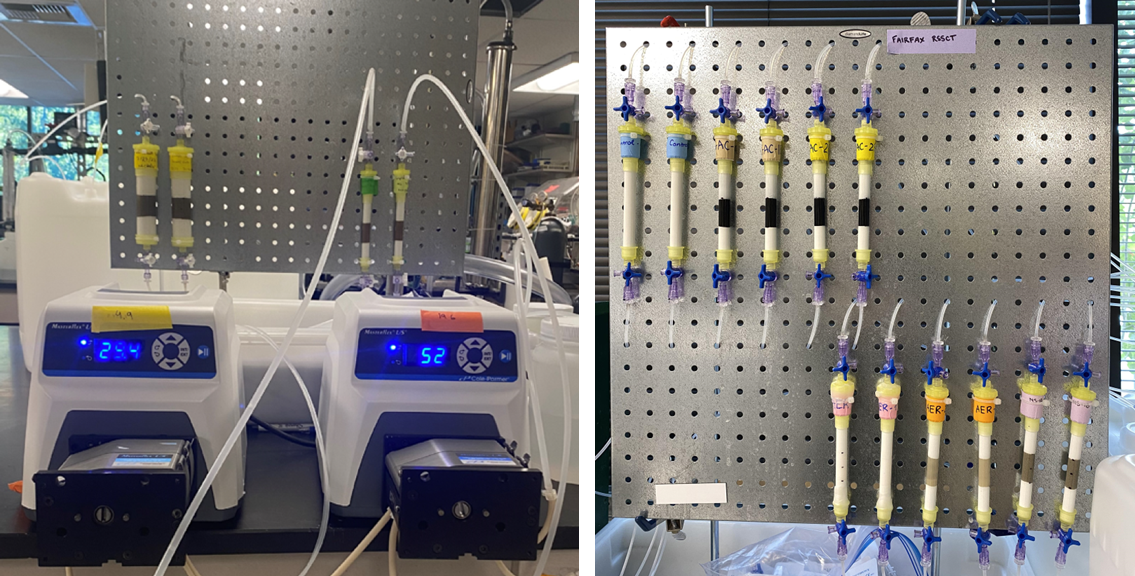
Nearly 100 bench-scale experiments were conducted over the last five years by CDM Smith to evaluate the applicability of employing rapid, small-scale column test (RSSCT) as well as non-RSSCT protocols to assess PFAS removal from groundwater and surface water using GAC, AER, and NS products. Specifically, experiments were designed to assess the applicability of scaling the overall rate of PFAA uptake to both ground and unground GAC, AER, and NS products. A compilation of data from large number of RSSCTs performed on a variety of water chemistries was used to determine impacts of geochemical conditions, specific PFAS present, presence of treatment residuals, and presence of co-contaminants on PFAS treatment effectiveness and media longevity. Lessons learned regarding media permeability reduction, unintended changes in water quality, and other practical engineering considerations will be provided.
Results/Lessons Learned
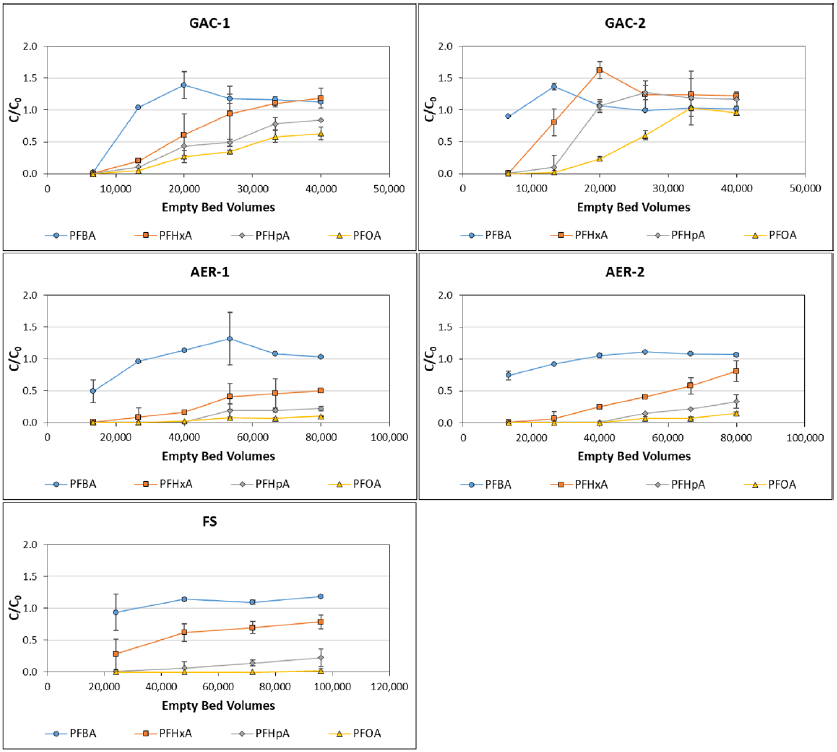
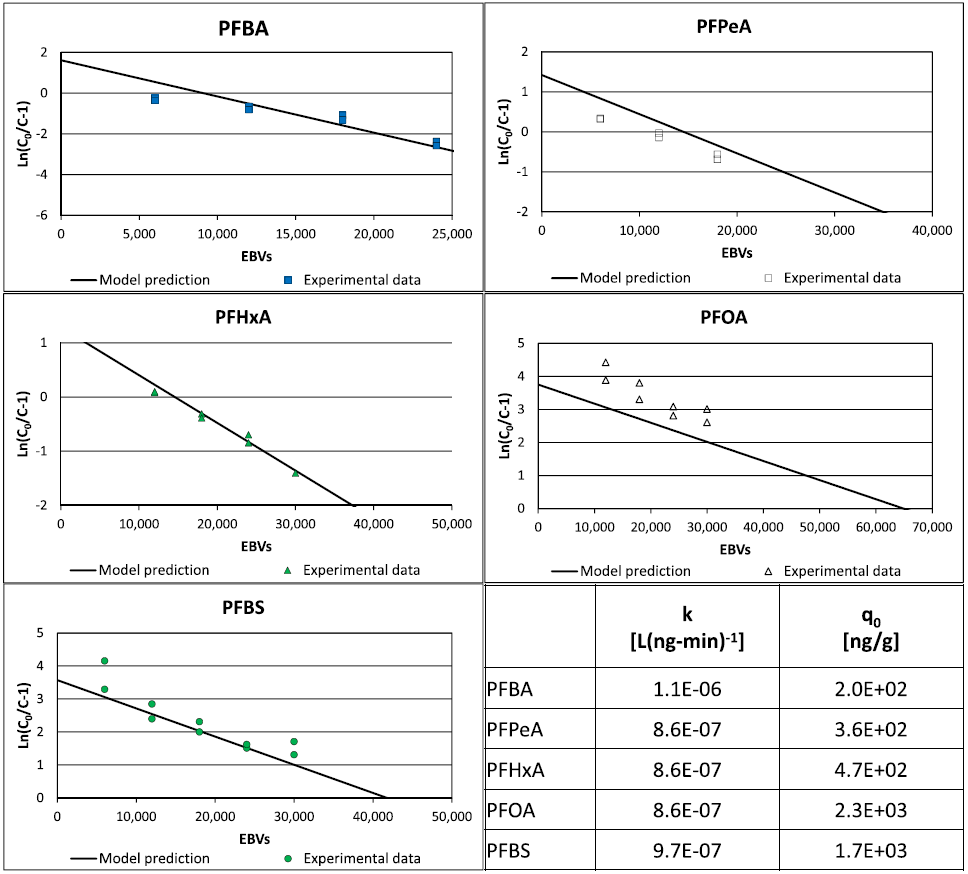
Distinct differences in PFAS treatment efficacy were observed for a number of commercially-available GAC, AER, and NS products tested. For all media examined across a variety of water chemistries, short-chained PFAAs generally broke through the columns more rapidly than the long-chained counterparts. Also, for a given perfluorinated chain length, the perfluorinated carboxylates broke through more rapidly than the corresponding perfluorinated sulfonates. PFAA elution through the GAC, AER, and NS products was well-described by the Thomas model, which assumes rate-limited uptake and Langmuir-type sorption. Results also showed that appropriate scaling (r−2) was valid as long as PFAA adsorption to (or near) the particle surface was taken into account by scaling the equilibrium sorption capacity to r−0.5. Including these scaling factors resulted in excellent agreement between the ground and unground results. Results from the various RSSCTs performed on varying water chemistries also indicated that even relatively low concentrations of chlorine (~0.3 to 0.5 mg/L) and polyphosphate (3 mg/L for corrosion control), and slightly elevated TOC (~2-4 mg/L) can adversely impact AER performance and longevity. Similarly, even low level of VOCs as co-contaminants (~10-20 µg/L) and a slight elevation in TOC (~2-4 mg/L) can have a detrimental impact on GAC performance and longevity. These studies highlight the importance of desktop and bench-scale evaluations prior to pilot- and full-scale implementation of PFAS adsorption treatment systems. Important design, cost, and performance monitoring considerations pertinent to full-scale treatment system implementation will also be presented.
Modeled PFAA removal in Unground NS Media Using Scaled Ground Data
PFCA Migration in GAC, AER, and NS Column Effluent